Benito Mussolini stepped out onto the Piazza del Campidoglio at 10:58 within the morning of April 7, 1926. He had simply delivered a speech ready for him through his lover, the Jewish creator Margherita Sarfatti.
The speech were a luck, and Mussolini left happy, making his manner during the cheering crowd.
Abruptly, a lady approached inside a couple of meters of the Duce. She used to be protecting a Lebel, a perilous revolver issued to the French military all over the primary global warfare. She pointed it on the dictator and fired.
Mussolini in a while after the assassination try which grazed his nostril.
wikimedia
Blocked and overwhelmed through the gang, the lady used to be straight away arrested and brought to the Mantellate jail (a Roman feminine jail), the place she gave her private main points. She claimed no longer to keep in mind the assault and seemed unusually calm and detached.
The lady in query used to be Violet Albina Gibson, the daughter of the first Baron Ashbourne Edward Gibson. The Baron used to be the Lord Chancellor of Eire for nearly two decades (1885-1905), sooner than its independence from Nice Britain. Gibson used to be born in Dublin on August 31, 1876, right into a pro-British Anglican circle of relatives.
After the assassination try, Gibson used to be branded insane. The political cause in the back of the assault used to be hushed as much as scale back the embarrassment of each British and Italian governments.
Most effective through downgrading the assault to the mindless behaviour of a madwoman – judicially qualified through a courtroom – may just it were imaginable, as certainly took place, to continue with Gibson’s repatriation, as all events was hoping.

The Insights phase is dedicated to high quality longform journalism. Our editors paintings with lecturers from many various backgrounds who’re tackling a variety of societal and medical demanding situations.
This model of historical past used to be believed for many years. It used to be best in 2014 that Gibson’s tale used to be introduced to a much broader target audience through the documentary, Violet Gibson, The Irish Girl Who Shot Mussolini, in accordance with the paintings of historian Frances Stonor Saunders. In any case, in 2021, Dublin Council honoured her stand in opposition to tyranny with a plaque outdoor her adolescence house.
Now, new proof buried in quite a few Italian archives, exposed through one among us (Giovanni), additional substantiates Gibson’s transparent anti-fascist political motives and divulges how the assault used to be sparsely deliberate. It presentations how:
When Gibson moved to Rome, she lived subsequent door to the Duke of Cesarò, an opposition chief, distinguished anti-fascist and a person she would later declare used to be her lover.
Gibson’s acquaintance with the Duke used to be additional corroborated through a brand new research of her psychiatric file.
Gibson moved to Italy after the homicide of Giacomo Matteotti, the socialist chief abducted and killed through a fascist squad.
Gibson travelled to the small the city the place the trial of Matteotti’s murderers happened.
Proof from a number of key witnesses used to be not noted or twisted.
Who used to be Violet Gibson?
On the age of 18, Gibson used to be a debutante within the courtroom of Queen Victoria. Debutantes had been younger, upper-class girls who had been offered to the monarch to mark their reliable access into prime society and the wedding marketplace.
Gibson used to be photographed status subsequent to the longer term King George V in 1897 all over a consult with to the Ashbourne circle of relatives in Howth Fort, when he used to be Duke of York.
In warfare along with her circle of relatives, Gibson transformed to Catholicism on the outbreak of the primary global warfare and Scotland Backyard registered her “anti-British pacifism”. Through the years, she would increase a Christian-socialist angle that noticed her sympathise with the deficient.
She additionally had robust ties to Italy, a rustic she had visited ceaselessly and for lengthy classes as a tender lady. In part on account of her father’s passion in Italian reunification, on which he had written widely, she had all the time adopted Italian politics with hobby and apprehension as the rustic used to be falling in opposition to right-wing extremism.
She used to be extraordinarily anxious about the upward thrust of fascism, beginning a minimum of from the 1923 assassination through a fascist squad of the priest Don Giovanni Minzoni.
Matteotti’s homicide, on June 10, 1924, is one among Italy’s maximum notorious chilly instances which one among us (Andrea) has researched widely.
The suspicions of Mussolini’s involvement in plotting his homicide ushered in a protracted length of disaster that the Duce best controlled to conquer in January 1925. It sped up his authoritarian go with the flow towards dictatorial energy, with improve he had received from King Victor Emmanuel III.
British response to Gibson’s arrest
There have been violent reactions from the fascist motion following Gibson’s try. The fascists had been through then an impressive power within the nation and had been calling for revenge in opposition to those that had dared to plan in opposition to the pinnacle of presidency.
George V’s embassy in Italy issued a commentary the day after the assassination try. It mentioned the embassy used to be blind to Gibson’s presence in Rome, believing that she used to be interned in a nursing house in England. King George V himself, possibly embarrassed through that outdated photograph of himself, straight away condemned “the ignoble attack”.
British Overseas Secretary Sir Austen Chamberlain additionally expressed “horror” on the act dedicated through a lady belonging to the British aristocracy in a telegram to Mussolini.
Now we have additionally reviewed correspondence, saved in the United Kingdom’s Nationwide Archives, despatched from Chamberlain within the aftermath of the try. In those messages he urged Ambassador to Italy Sir Ronald Graham to assist Italian investigators. The ambassador instructed Chamberlain he had “little doubt” that Gibson used to be “a tool of outside influence”. Nonetheless, Chamberlain urged him to indicate she used to be mad and he or she must be in a psychological establishment in England. He mentioned this is able to minimise repercussions at the hitherto just right global family members between the 2 international locations, reporting additionally that Churchill used to be “charmed by Mussolini”.
Virtually in unison, Gibson’s members of the family additionally denied that there may well be any political importance to her movements. They promised, if launched, she could be correctly cared for in a well being facility in England.
Investigations
All through the preliminary interrogations with the Justice of the Peace (which happened underneath the liberal penal code of Zanardelli) in 4 separate interviews in April, Might and June 1926, Gibson endured to state, rather vaguely and confusingly, that she didn’t bear in mind seeking to shoot Mussolini.
Then, in mid-June, the defendant’s angle modified.
On June 12 and 16, underneath the steerage of attorney Enrico Ferri and assisted through Bruno Cassinelli, she confessed to being chargeable for the assault and claimed she had an associate – the distinguished anti-fascist flesh presser, Duke Antonio Colonna, Duke of Cesarò (1878-1940).
She additionally claimed she used to be insane. This looked to be sufficient to quell rumours of a conspiracy. It used to be all of the paintings of a mad lady, appearing on my own.
However a query loomed: what used to be Gibson doing in Italy within the first position?
New proof
Our contemporary vital research of the trial paperwork presentations that Gibson arrived in Italy along with her lady-in-waiting Mary McGrath in October 1924 and lived in Rome at By way of Gregoriana. This used to be only some steps clear of the Duke of Cesarò’s space in By way of Gregoriana. But if she mentioned her actions throughout Rome in next interviews, she by no means discussed this cope with.
This, in conjunction with the Duke’s admission of getting met Gibson in 1912 in Munich at a convention of the Theosophical Society, means that – regardless of the Duke’s denials – he and Gibson had met in Rome previous to the tried homicide.
Moreover, it is very important rigidity that Gibson’s spouse in Italy, Mary McGrath, distanced herself from the present circle of relatives angle that attributed Gibson’s psychological infirmity as the reason for the assault.
Our archival analysis obviously presentations that, when summoned through the Italian Consul in Dublin on Might 19, McGrath maintained that she didn’t imagine her mistress used to be insane, or even added that she suspected she used to fulfill many of us on a daily basis all over her keep in Rome.
When investigators in Rome approached McGrath after the taking pictures she confirmed heartfelt sympathy in opposition to Gibson however she shied clear of backing up the circle of relatives’s principle about her woman’s madness. She used to be, in reality duly paid and repatriated to Dublin through Gibson, simply previous to the assassination try.
Then again, from the defendant’s rather extravagant and in our view fairly intentional judicial behaviour (claiming to be each mad and chargeable for the crime), an altered psychological state emerged all over interrogations that used to be used to indicate the lifestyles of a cognitive bias.
Via stating herself insane, she denied complete accountability for the felony act. Additional doubts additionally arose from the truth that she instructed the professionals she beloved the Duke of Cesarò, but endured to denounce him as an associate.
Underneath the liberal penal code in power on the time, admitting accountability for the assault whilst concurrently stating herself insane (and due to this fact irresponsible for the act) compelled the Justice of the Peace to reserve a psychiatric analysis.
From the testimonies accumulated all over the police investigations and assessments performed through the skilled police commissioner, Epifanio Pennetta, different essential facets emerged.
Even supposing they had been willingly denied through Gibson, those findings showed as a substitute the defendant’s transparent premeditation of the assault, performed with anti-fascist motivations.
Opposite to this viewpoint, erasures and misrepresentations would as a substitute emerge, which will best be defined, traditionally, as prejudicially influenced through the Mussolini regime.
Those facets weren’t permitted as vital proof within the Particular Army Tribunal – which took over the case – and weren’t therefore tested through historians, excluding some references within the ebook through American historian Richard O. Collin, who used to be the primary to shed some mild into the Gibson affair in 1986.
Attending Matteotti’s trial
A vital piece of proof which used to be not noted through investigators on the time used to be the truth that a number of witnesses testified to having observed Gibson attend the trial in opposition to Giacomo Matteotti’s assassins in Chieti between March 16 and 24, 1926.
Those testimonies are extremely vital: best religious anti-fascists travelled to the small mountain the city the place the regime had moved the extremely delicate trial.
Travelling to Chieti used to be neither simple nor simple on the time – even now it takes 3 hours through coaches which didn’t exist on the time. It required an excessively critical dedication.
Against this to those witness testimonies, Gibson would categorically deny having attended the trial.
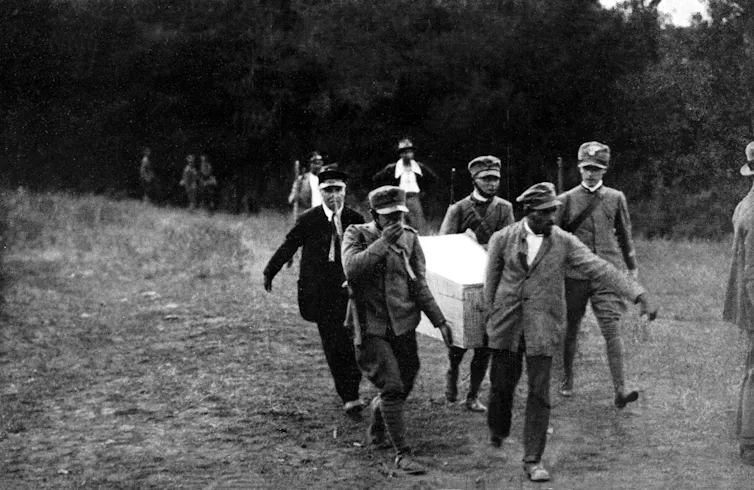
The frame of socialist chief Giacomo Matteotti is found out at the outskirts of Rome on August 16 1924, two months after his disappearance.
Archivio GBB/Alamy
Strangely, she used to be believed through the army magistrates regardless of their very own confirmation within the ruling that her previous, provide and long run statements must be prejudicially deemed false and unreliable.
Upon her go back to Rome from Chieti, most likely disenchanted through the end result of the felony court cases, which had ended in best mild convictions for Matteotti’s assassins, Gibson would show her need to put into effect a plan she had possibly already conceived for a while. A plan that used to be stored secret.
Then, on March 28, 1926, witnesses interviewed all over the initial investigation reported her presence at Villa Glori – on the anniversary of the founding of the Fascist Birthday celebration, attended through Mussolini.
Gibson additionally denied being at this match and used to be, once more, believed through the magistrates.
It’s essential to focus on that this episode took place a couple of days after the tip of the Matteotti’s assassin trial and in a while sooner than the occasions of April 7.
Those testimonies, which the army judges didn’t credit score, lead us to suspect that Gibson could have already been considering an assault on Mussolini in this instance – suggesting transparent premeditation and constant anti-fascist motivation.
The psychiatric file and a lover
On July 8, 1926, psychiatrists had been appointed. Sante De Sanctis and Augusto Giannelli had been the circle of relatives’s professional witness and the court-appointed professional witness, respectively. The professionals had been requested whether or not, “Miss Gibson was rationally aware and free of will at the time of the accused act”; if the accused used to be affected by psychological madness, and “how the statements recently made to the investigating magistrate should be considered”.
Within the professional file, Gibson reiterated that she were influenced through the Duke of Cesarò, who alternatively, she additionally claimed to “love very much”.
This got here as a wonder to the professionals who attempted unsuccessfully to focus on the anomaly she used to be falling into through stating that she beloved a person who she ended up harmful through her accusations.
Even supposing stating to have a great deal beloved the Duke of Cesarò, Gibson didn’t display any be apologetic about in accusing him, possibly revealing the bitterness and resentment of a few romantic myth.
In August, the psychological well being professionals’ unanimous verdict used to be that the defendant used to be partly insane and due to this fact may just no longer be chargeable for her crime.
The undercover agent and the Particular Army Tribunal
In the meantime, Mussolini used to be pushing ahead his authoritarian schedule. In Autumn 1926 there were two extra makes an attempt on his lifestyles from the younger anarchists Gino Lucetti and Anteo Zamboni (either one of whom overlooked their goal).
In a revealing second, on listening to of Lucetti’s try, Gibson (who used to be in custody) confided to a nun that “it was a pity that he missed”.
The federal government took good thing about the location through urgent on with its “hyper-fascist laws” which dissolved all political events, ended Parliamentary democracy and offered a Particular Army Tribunal for crimes in opposition to the regime. Crucially, the brand new tribunal may just inflict the loss of life penalty, which used to be reintroduced 37 years after its abolition.
It’s value noting at this level that, in line with Italian historian Mauro Canali, one among Gibson’s legal professionals, Bruno Cassinelli, used to be additionally an informant for Mussolini’s govt, with the codename Brucassi.
He had already defended Giovanni Corvi, a communist that had killed the fascist MP Armando Casalini in September 1924 (shouting “Vendetta per Matteotti”), and who used to be additionally judged mentally insane.
It’s simple to consider that Gibson’s judicial technique (defended through the similar attorney) used to be additionally geared toward acquiring the similar declaration of madness from the army judges. And in contrast to the unique judges, the army judges had been influenced through Mussolini who at that time used to be thinking about keeping up just right family members with the British govt.
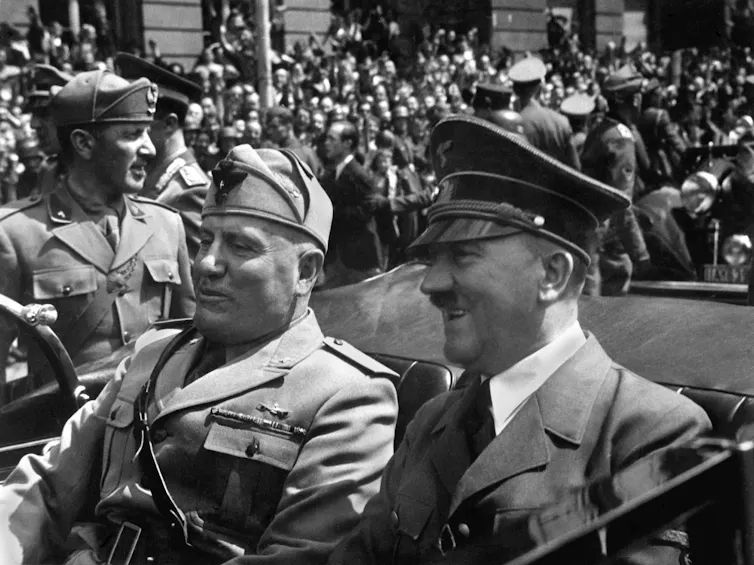
Mussolini with Adolf Hitler in Munich in 1940.
Shutterstock/Everett Assortment
The primary ruling of the newly operational Particular Army Tribunal, used to be with the Gibson case.
The case used to be handled in a personal listening to and a verdict used to be reached on Might 6, 1927. The primary level reiterated widely through the army judges used to be that not anything however lies may well be anticipated from Gibson.
It used to be due to this fact crucial to stop those scandalous lies from being uttered in a public listening to. The ruling due to this fact established that each her previous and provide statements and those who will have been made in a public listening to had been to be prejudicially deemed false and unreliable.
The general choice on Gibson’s psychological infirmity used to be taken, uniquely, through army judges, who based totally it on “legal-ethical” causes.
The decision
In this foundation, the Particular Army Tribunal, having not noted all politically related facets of the former investigation, on Might 6, 1927, independently dominated that there used to be “no case to answer against Violetta Albina Gibson, regarding the crimes she was charged with, because she is not punishable by reason of mental illness”.
The decision, which explicitly discussed “the intervention of his excellency Benito Mussolini”, ordered her unencumber to ensure that Gibson to be admitted to a psychological asylum for remedy.
But, the police government, quite than turning in her to a Roman psychiatric health facility, as had took place in an identical instances, launched her, as soon as once more, on Mussolini’s orders.
Go back to England
The regime passed Gibson over to her sister, Constance, On Might 9, 1927, in a breach of the standard process. 3 days later, the sister accompanied Gibson again to England on a protracted teach adventure. With them, undercover Italian police, one Italian nurse, 3 English nurses and a commute company attendant. None of them had been dressed of their standard uniforms and Gibson didn’t know what used to be about to occur to her.
Some members of the family and political figures expressed gratitude to Mussolini for liberating one among their compatriots who had “senselessly” tried to kill him. In compliance with the ruling of the Particular Army Tribunal in Italy, which had erased the political motivation and judicially qualified the defendant’s madness, an extra psychiatric analysis used to be ordered to substantiate her psychological sickness.
The “senseless” motivation for the assault used to be temporarily showed with a certification of madness rushed thru through Maurice Craig and Bernard Hart, two docs in Harley Boulevard. Gibson used to be admitted to St Andrew’s Sanatorium in Northampton (a the city round 60 miles north of London) the place she would stay segregated for nearly 30 years.
In April 1930, at the fourth anniversary of her assassination try, she attempted to take her personal lifestyles, however a nurse discovered her sooner than she may just. Most effective her sister Constance stored visiting within the health facility, whilst the remainder of the circle of relatives stored their distance.
During her time at St Andrew’s Sanatorium, she many times pleaded for her liberation in letters to her circle of relatives, to the Queen and to contributors of the federal government, together with Winston Churchill.
When the younger Princess Elizabeth married Prince Philip, in 1947, Gibson wrote her a transparent, variety and easy letter which learn:
Within the happiest length of your lifestyles, I make this request that you just write to the House Secretary announcing that you’d be satisfied if he would unencumber me from this psychological health facility in order that I will be able to pass right into a convent…In 1926, I shot at Mussolini and used to be close up on this health facility for the process His Majesty’s excitement. I’m really feel fairly positive that your kind-hearted grandfather would no longer take any excitement in holding me right here any more, twenty weary years and 6 months. I’m now outdated, bed-ridden with very dangerous center illness and different sicknesses…You’re going to no longer want to worry that I will be able to ever shoot any person once more as I’m outdated and sick and occupied in very quiet issues, particularly prayers. So should you get me my freedom, I’m positive that this kind of variety act will convey a blessing to your marriage…
As with many of the different letters, it used to be by no means despatched they usually lie in St Andrew’s Sanatorium archive.
Epilogue
Antonio Colonna, the Duke of Cesarò – the person Gibson professed to like – used to be compelled to retire from politics after her arrest and the investigation over his position. He died in Rome, elderly 62, in 1940 only some months after fascist Italy had declared warfare on Nice Britain.
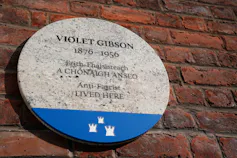
A commemorative plaque used to be unveiled for Violet Gibson at her adolescence house on Merrion Sq., Dublin, in 2022.
PA/Alamy
The collective reminiscence of Gibson used to be for a very long time formed through the slim conception of psychological well being within the early twentieth century, the diagnostic conclusions of Italian and British psychiatrists and the global settlement between governments that had her confined in a psychological establishment.
Gibson died in St Andrew’s Sanatorium, on Might 2, 1956, a couple of months sooner than her eightieth birthday. No buddies or circle of relatives attended her funeral.
In her will, she asked a requiem mass and to be buried in a Catholic cemetery – this ultimate want used to be not noted through her circle of relatives.
Gibson got here nearer than any person to killing Mussolini. Her try used to be neatly deliberate and finished. Had she succeeded, the historical past of the twentieth century would were very other.
For you: extra from our Insights sequence: